"New Canadian Immigrants" Circa 1916...Finnish Settlers in Northern Ontario
Canada a Land of Opportunity and Immigrants
Immigration from another country is always tough on new immigrants.
While it is a time of great hope, there are many obstacles on the path to make a new country home. Each wave of immigrants have faced their own challenges to make Canada their home!
This is the story of some of my people as they came to a new land.
Irish, German, Italian and Ukrainian Immigrants have similar stories.
In this modern day immigrants sometimes feel undue hardship. Take heart, times have improved! This isn't to say there are no challenges, but technology has improved many aspects of creating a new life.
This is an account of how the grandparents and great grandparents of some modern day Canadians made their way to the land of opportunity. Their life did not include modern conveniences. When they left their homeland, it was often forever. Letters were the only contact with loved ones at home.
I do remember that telephones were a luxury when I was quite young. In my grandparents time there was not even that opportunity for keeping touch with loved ones. Only letters. How sad it must have been. My father never saw his father again, except in photographs.
There are other historical perspectives written by more scholarly minds than mine, but this will do quite well, since the sources are primarily my late stepmother, my aunt and elders who lived part of this life. The stories I heard as I grew up in the predominantly Finnish Canadian community which was a part of an original settlement in Northern Ontarioare part of my history because as a young child, I was also an immigrant.
This is a brief account of the immigrant life since 1916 in one rural area of Ontario, where one the first waves of Finnish immigrants settled in the distant past.
The account is adapted from the writing of my late stepmother with some editing by me. I recently found a handwritten account tucked into a volume of poems I had given her years ago. It is as if she wanted me to publish it…so here it is…part of her life and times.
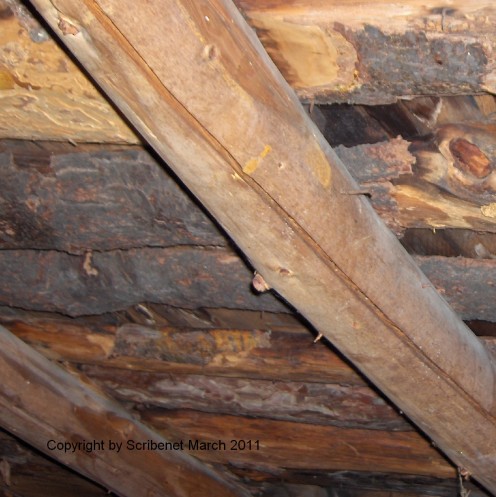
Rafters from a pioneer home...note how different from modern homes!
Immigration then...
The first immigration to Northern Ontario was in 1916. My stepmother’s parents arrived from Finland shortly after, in 1918. They began life in the town of Creighton Mine, which no longer exists!
My stepmother’s father was employed at the INCO mine there. Conditions were grim and dangerous for the men that worked those first mines. They were truly pioneers. There was no health plan or compensation for illness. The men took their chances and many died as a result of their working conditions.He was one of them. My stepmother was a Canadian, she was the first of her family to be born in Canada. Her father died of black lung disease from the mines when she was still a toddler. Her mother never remarried and raised 5 children on her own.
The Canadian government had allotted homesteads to immigrant families as an incentive to immigrate. The deal was a deed to a certain amount of acreage in exchange, if the families cleared a certain amount of land and began farming. The area where my mother’s parents settled became a
It seems, the area reminded the immigrants of their homeland. However, much of the good agricultural land was already taken, so farming was not an easy option;but the lure of their own land was enough.
Never mind, the Finnish people were used to hardship and this was no free giveaway. Hard work was required to to survive the harsh winter (families came over with very little reserves and received no further assistance from the government of the day). The area, though rich in timber, was difficult to grow crops in, but the settlers persevered. Families helped each other out, it was the only way to survive!
A New Life Begins...
The immigrant people did not look at what they did not have, but focused on what they thought they had; prime timber, which they used to build their homes...no contracters in those days! The families banded together and used whatever they could to create those first homes.
The cleared land grew enough vegetable and grain crops to supply families with simple food year round. Children didn’t have the luxury of technology or computers, they had to work the land with their parents in order to have food (potatoes, turnips,carrots) and pick wild berries (strawberries and blueberries..that were preserved) to survive the winters. Meat was not store bought. They raised their own, once they could afford to buy the animals to grow or they fished and snared small, wild animals like rabbits. Perhaps today we would call that survival living!
The nearest convenience store or mall didn’t even exist! Life was simple but wholesome. Both my mother and her sister recounted, with affection, anecdotes of their childhood. Straw beds with a pile of children per bed. Children beginning work at a very young age to bring in money that was in very short supply in order to buy fabric to sew clothes and buy the basics such as shoes!
All the children went out to work before they were adults to add to the family resources. One of my uncles remained behind to help the grandmother farm until he married. My stepmother married at the age of 17 and found work as a hairdresser and later as a sales woman until she finally became a stay at home mother in her thirties!
Every Finnish family had to build their own sauna and Saturday “sauna night” was the luxury of the week!
The community had a wholesome friendliness, people were always ready to help one another.
Soon the first roads were built. Horse and buggy were the mode of transportation. When cars were introduced there was a sense of awe and wonder at this modern conveyance!
The children of the settlers first went to school at the Finnish hall…followed by a two room school that was completed in 1926. Four different grades were taught in each of those two rooms. Each student walked two or three miles to school and back each day; skiing in the winter. Initially, there was no indoor plumbing, no electrical lighting and no proper heating in winter…but it was a start.
That school still stands in the community, though it has long become a community center and children are transported to a neighboring community school with all the modern conveniences. They are picked up from their own doorsteps by bus.
The old Finnish hall was a gathering place and countless four act plays and musicals were enacted by the community’s very own theatrical group. As well, there was a thriving athletic community with the stars of the day taking the spotlight for their stellar abilities in track and field, gymnastics as well as skiing.
My aunt wrote in one her own accounts, that only one family member could go to an event at one time because there was only one set of felt boots shared by the whole family! Mom and her sister always looked back on those days with nostalgia... which is difficult to fathom in our age of conveniences we take for granted.
The Depression was a trying time for all. Almost all the families took in at least one single man since there were no jobs and the men would work for food since the families had not much else to offer and the extra help was appreciated since the wages were low (zero).
The second world war which broke out in 1939 and almost all the men of age enlisted or were asked to serve. Some never returned. V-day was a day of great joy for the families as war finally ended and families were reunited and life returned to normal.
Adapting
By the 1950’s families had adapted, some of the older generation had passed away and electricity was the new luxury for the small community. This meant lights and the new conveniences of electric washing machines and the best convenience of all…fridges to keep food cold!
The older generation wondered at the laziness of the younger women getting soft watching their wash done by machine instead of the old washboard!
In one incident of a power outage...the lights went out as they are still apt to do during storms, but the locals who were new to electricity decided the wiring had failed. In another incident one hapless man took his new iron apart until by some fluke they discovered the iron would not work because a fuse was burned out in the electrical panel. It was a learning curve!
As if that wasn’t enough technology to deal with, the telephone was introduced to the community. Now that was considered a downright miracle. The first service was nine families to a rural line…can you just imagine all the listening that was done to any conversation! Yes, they did listen in on each other...I have heard the stories...ha,ha,ha. The original wiretap.
The immigrants have long since become Canadian citizens and their children are Canadian by birth. Their grandchildren no longer even understand their heritage language or hardships their great grandparents endured of long ago...
They forget their great grandparents were once new immigrants with a few suitcases of old clothes to their names; their eyes filled with hope of a better life! There were hardships to endure, but most of them did eventually find the better life! Their children and great grandchildren have come to love Canada as their home, as will the children of the many new immigrants coming to Canada today!
Welcome! You are not the first. You too, will be welcoming immigrants from other places one day, eyes full of hope for a better life!
- In the Finnish Steam Sauna (in Canada) - How to Use a Sauna
Directions on how to enjoy a relaxing and safe sauna with some sauna history and video